Green Island

Owned Property
The McKenzie River Trust purchased the property in fee title with the support of several key partners.
Celebrating 20 Years at Green Island
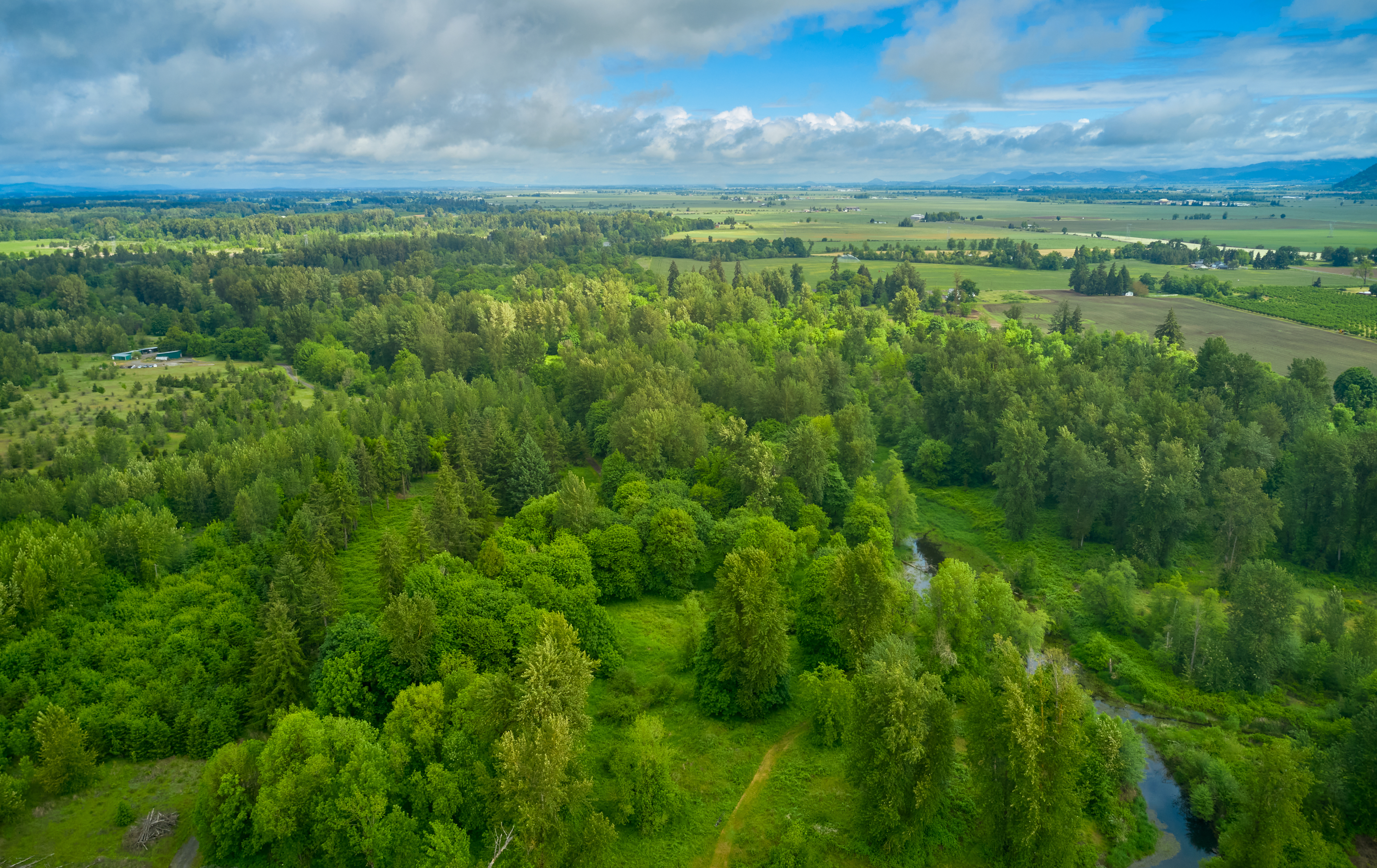
In 2023, McKenzie River Trust celebrated the 20th anniversary of the purchase of Green Island. This celebration gave us time to pause and reflect on the many hands who have helped us to put love into the land. We encourage you to follow the link below and learn more about the incredible story of how people came together to restore nearly a thousand acres of land where the McKenzie and Willamette rivers meet.
Meet Green Island
Located at the confluence of the McKenzie and the Willamette Rivers, Green Island contains some of the least altered fish and wildlife habitat in the Willamette Valley and provides essential habitat for numerous species. At more than 1,100 acres, Green Island offers an opportunity to make an impact on a landscape level. Research has “demonstrated that much of the complexity (~80%) of the active channel has been reduced over the last 150 years. These changes have resulted in a loss of connectivity between the river main channel and OCH. In the reach of the river between Albany and Eugene from 1850 to 1995, about 80% of the area of islands, 41% of the area of side channels, 80% of the area of riparian forest, and 74% of the area of alcoves and sloughs has been lost”. (Willamette River Panning Atlas, Hulse, D., and Gregory. S.).
The Vision
Our vision for Green Island is to restore a robust ecosystem comprised of a rich mosaic of historic habitat types. Cooperative partnerships dedicated to innovative, flexible and adaptive management carry this vision to success. Restoration goals also include allowing the river to move dynamically, as it would have historically. Anastomosing channels, the formation of new gravel bars, the sloughing off of banks, trees falling into the river – these are all natural processes we are encouraging.
Partners
McKenzie River Trust purchased Green Island in 2003 from the Green family, who owned and farmed the land for over 70 years. They wanted to see it protected and restored for the benefit of wildlife and the communities of the southern Willamette Valley. We’re grateful for the partners that helped support this project through funding and volunteering:
- The Oregon Watershed Enhancement Board (OWEB)
- North American Wetlands Conservation Act (NAWCA)
- Eugene Water and Electric Board (EWEB)
- Bonneville Power Administration (BPA)
- US Fish & Wildlife Service (USFWS)
- Oregon Dept. of Fish & Wildlife (ODFW)
- US Environmental Protection Agency (EPA)
- Northwest Youth Corps (NYC)
- University of Oregon
- Oregon State University
- Community volunteers
- Local high school and middle school students
- Business supporter groups
The Bonneville Power Administration (BPA) holds a conservation easement on the property, which insures that Green Island is managed in a way that protects natural resources, maintains or enhances air or water quality, and preserves its underlying archaeological or cultural resources in perpetuity. In addition, the State of Oregon, by and through OWEB, is a third party beneficiary to this easement.
The United States Fish and Wildlife Service’s Partners Program and Oregon Department of Fish and Wildlife’s Willamette Wildlife Mitigation Program, as well as numerous other partnerships, support these conservation activities.
Restoration
Restoring the floodplain forest is a key element in enhancing the habitat on the property for native wildlife. Since 2006, McKenzie River Trust converted more than 450 acres of Green Island from agriculture fields to floodplain forest or riparian habitat, more than 65 acres to native grassland, and more than 15 acres to upland/oak forest. To date over 650,000 native trees and shrubs have been planted on the property, and many more are yet to come. These trees will grow to become a gallery forest and provide refuge for birds, bugs, frogs, snakes, salamanders, beavers, otters, coyotes, deer, and all the creatures that visit and live on this land.
We are also enhancing natural river flow processes on Green Island, including:
- Flooding,
- Channel migration,
- Groundwater interaction
- Formation of backwater areas
Our team removed more than 5,600 feet of levees from the Island, permitting high waters to flow through swales and portions of the property. This connected the area channels to the river flow for the first time in 35 years. We’re planning to remove additional levees so that backwater channels on the property will reconnect. Bringing back the river’s flow to these channels will provide critical habitat for juvenile spring Chinook and Oregon Chub.
Animals on the property
Green Island is home to numerous fish and wildlife species. We’ve recorded several federally- and state-listed threatened and endangered species such as:
- Spring Chinook salmon
- Oregon chub
- Western pond turtle
- Red-legged frog
Volunteers, scientists, and staff identified 156 types of birds on the property including:
- Western meadowlark
- Pileated woodpecker
- Black phoebe
- Great blue heron
- Osprey
A complete copy of the Green Island Bird Checklist can be downloaded here.
Beavers, salamanders, and other iconic Oregon species can also be found on the property.
Research
The Environmental Protection Agency, Oregon State University and the Oregon Department of Fish and Wildlife are actively using the property as a field research site. Findings from their work helps us understand the intricate relationship between surface and ground water, floodplain function, and water quality. Research has also included study of spring chinook, coastal cutthroat, Oregon chub, stickleback, amphibians, and the impacts of bullfrogs on native species, just to name a few.
Volunteer
Many volunteers and partners have helped to plant and maintain thousands of trees and shrubs on Green Island. They’re also working to control invasive weeds like Scot’s broom, Himalayan blackberry, water primrose, and more. This work continues today, and you can help! To get involved, visit our volunteers page.
The McKenzie River Trust offers regular tours of Green Island led by volunteer experts. Upcoming tours will focus on birds, native plants, bats, moths, and dragonflies and damselflies. Sign up for our contact list to be the first to hear about all our events and tours.
Explore Green Island
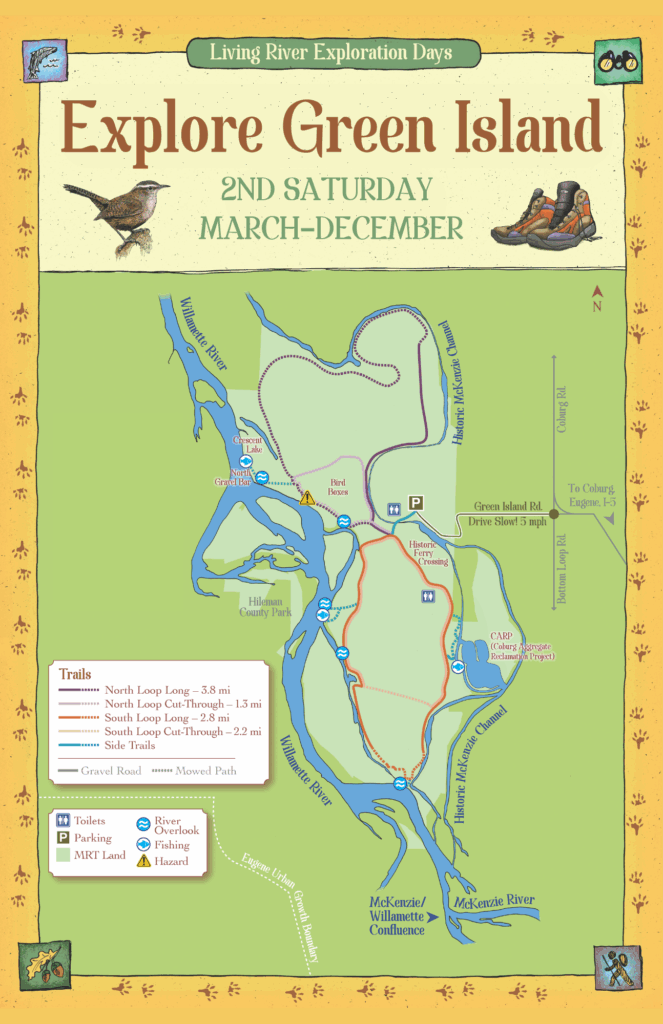
Explore Green Island on the second Saturday of each month, March through December during our Living River Exploration Days.
Because this property is a privately owned space in active conservation, there are a few things to know before you visit:
- No pets, please. This area is in conservation, and all domestic animals are prohibited.
- There will be a port-a-potty available, but no other facilities.
- Bring water with you. There is no potable water on-site.
- Green Island is adjacent to public lands used for hunting during bird and deer seasons. You may hear gunshots during these seasons, but hunting is strictly prohibited at Green Island.
- Bikes are great. The trails are a mix of loose gravel and dirt farm roads, so big tires are better.
- Help us to be good neighbors! Please drive under 10 MPH past the houses on Green Island Rd..