
After 15 Years, haich ikt’ at’uu Comes to Siuslaw Estuary
On the foggy morning of May 29, a thick, earthen barrier was the only thing separating a restored dairy farm from its reclaimed destiny: an estuary to welcome back the Salmon People, as well as lamprey, shorebirds, and numerous plants not seen on the premises since the mid-1800s.
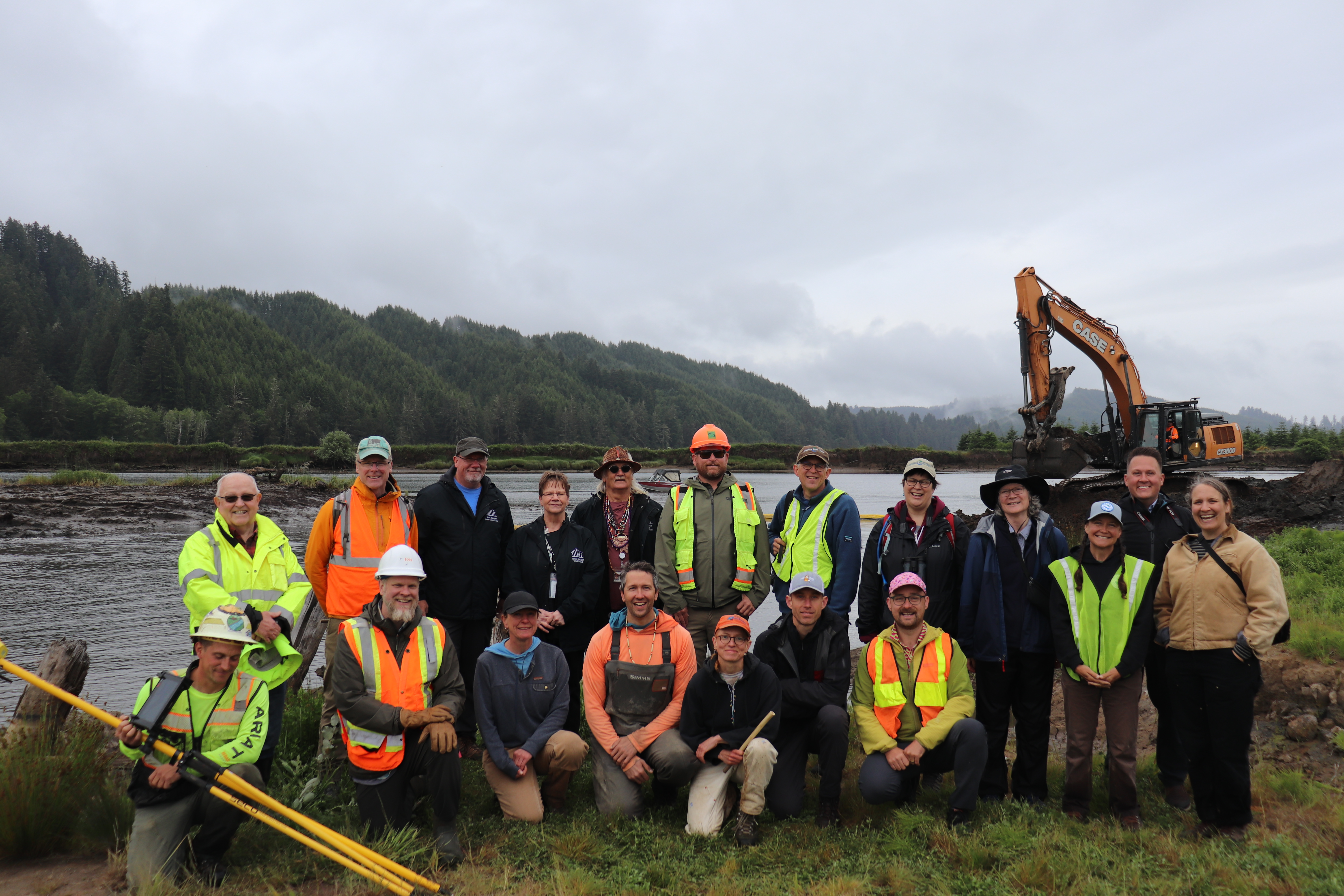
Tall, dinosaur-like excavators stood on either side of the levee, with a crowd of people from the Confederated Tribes of Coos, Lower Umpqua and Siuslaw Indians (CLUSI), the McKenzie River Trust, and the Siuslaw Watershed Council watching from roughly 50 feet away on a raised mound of earth, clad in hard hats and reflective vests.
Nearby, Dan Kirk, the restoration projects manager for CLUSI, waved a smoldering bundle of sage across the damp landscape.
“This is a big moment that a lot of our project partners and community members have been waiting for,” smiled Kirk. “It’s going to be really beautiful and amazing for everyone.”

Blessings have been done nearly daily for about a month, at a site that has undergone an incredible transformation since redevelopment began in the late summer of 2023. Contractors leveled out the terrain and removed drainage ditches and other agricultural fixtures, while in June 2024, CLUSI officials approved a new name for the 217-acre expanse: haich ikt’at’uu. It means “heart of the river.”
“It makes me think of heartbeat and pulse,” said Kirk, as they walked to the levee. “That’s what I get excited about, is just seeing the rhythm of the river do its thing.”
The McKenzie River Trust acquired the Waite Ranch site for $750,000 in 2010 with a grant from the Oregon Watershed Enhancement Board. Since then, the total cost has been roughly $16 million, according to Kirk. A large portion of that is a 1.2 mile earthen ridge -or berm- that protects the section of Highway 126 that runs adjacent to the estuary.
“Today we will be reconnecting the tidal Siuslaw River into the site,” said Kirk, as a survey team put up a wide yellow barrier called a silt curtain between the Siuslaw River and the levee. “So creating about 180 acres of new wetland that was historically tidal wetland before the mid-1800s when it became a dairy farm.”
Huddled with the observers was Margaret Treadwell, the central coast conservation program manager for the McKenzie River Trust. She had never seen a levee breach before, and was excited for what was to happen in the next few minutes.
“The waters of the Siuslaw River are going to come back into this place from the tide for the first time in probably over 100 years. It’s returning the natural processes to this place.”
Breaking down to rise up
At 7:33 a.m., an excavator lowered its toothed bucket against the earthen levee, and readily broke it apart as the onlookers cheered. River water coursed in immediately, seeping quickly into the area that hadn’t touched brackish water for generations.

“Keep an eye out for animals coming back in,” said Treadwell. She said wildlife has a way of knowing when things like breaches happen, and return to their ancient habitat.
“It’s a pretty good feeling,” said CLUSI Chief Doug Barrett. He’d performed a short ceremonial drum song to complement Kirk’s blessing of the estuary. Until this moment, he’d only really known of the site as farmland. Barrett was excited to see this transformed into a special place for the wildlife significant to his tribe.
“This is a pretty awesome place now to call our home,” he said, as the waters began to rise higher along the estuary channel. “And our salmon to call their home, and our lamprey.”
A trending push to reclaiming the land and the waters
The CLUSI is one of several Pacific Northwestern tribes that have reclaimed and restored coastal areas since the beginning of the millennium. In 2015, a levee breach was carried out by the Tulalip Tribes of Washington State, assisted by the National Oceanic and Atmospheric Administration, U.S. Fish and Wildlife Service, and the City of Marysville, among others. Named the Qwuloolt Estuary, the breach connected 354 acres of historic wetlands to the Salish Sea, which also created more favorable passage and conditions for salmon.
And at Similk Bay on the south side of Fidalgo Island in northern Washington state, a habitat restoration project is in the works that could help reverse the trend for chinook salmon, which are listed as an endangered species. The Swinomish Tribe and the Skagit River System Cooperative are collaborating on a 17-acre parcel of saltwater marsh habitat for juvenile chinook, namely a pocket estuary coordinators say will help the fish rebound. At last check, the project is expected to wrap up this summer.
Mizu Burruss of the Siuslaw Watershed Council said partnerships between tribes and nonprofit organizations like hers are essential as resources and bandwidth can be tight for just a lone group to tackle.
“They make them richer, better, more complex and diverse projects,” said Burruss. “When we’re talking about ecosystem restoration, that’s what we want.”
Closing ceremony through canoe
With the Siuslaw Estuary steadily filling up with river water, Chief Barrett made his way back to Florence. There, he joined the CLUSI tribal council and other officials at the Port of Siuslaw, and boarded “Lottie”, a 32.5-foot cedar canoe.
With oars at the ready, the dozen-person crew launched into the dark green waters of the Siuslaw River, and paddled roughly four miles eastwards towards the newly-opened channel of haich ikt’at’uu. Several seals and a sea lion were spotted on the way, and a small armada of kayakers joined the canoeists in the final leg of the journey.

The image could not have been more iconic of the traditional and modern worlds: the dugout canoe with its crew wearing woven basket-hats approaching a restored space still flanked by dump trucks and excavators, while several drones hovered above. Some people in the craft sang, as Chief Barrett and others threw tule seeds and tobacco into the estuary.
Jesse Beers, CLUSI’s cultural stewardship manager, carefully placed a woven grass mat bearing the remains of a salmon into the current, which swept it away towards the newly-formed habitat.
“We came in and did a protocol ceremony,” said Beers, after the canoe docked. “When we were in the channel, it almost brought tears to my eyes.” He said the salmon remains were to let the Salmon People know that this was a “good place” to come again, to “fatten up and be healthy.”
Beers said as the increasingly salty water flows in from the ocean, there’ll be less invasives and briars to contend with, and more cattail and tule growing across the restored space.
“Just seeing the breach actually happen after this long, it’s just an amazing experience.”
One last piece remains: a canoe landing which wasn’t installed yet by the time of the levee breach. The landing was suggested by CLUSI youth, who wanted cultural access to the area to interact and learn with the estuary’s environment. Organizers expect the canoe landing to be done sometime in July.
This article first appeared on Underscore Native News and is republished here under a Creative Commons Attribution-NoDerivatives 4.0 International License.