

When our Events and Outreach Manager, Holly, found a deceased shrew on Green Island, she was curious to learn more about which species may be calling these protected lands home. This seemingly straightforward question quickly led to one of the most interesting animal deep dives our staff have undertaken this year.
First off, shrews are not rodents. Despite a similar appearance to mice and rats, these long-nosed insectivores are in the order Eulipotyphla (eu·lipo·ty·phla), which also includes moles and hedgehogs. The 45-million-year-old shrew family boasts 385 species and a range of fascinating adaptations. Two of these unique species include the water shrew and Pacific water shrew. These shrews can be found walking on water with the support of specialized toe hairs that hold bubbles on their feet. Adept in the aquatic environment, they hunt by blowing bubbles and sucking them back up to smell underwater prey like caddis larvae and other aquatic invertebrates.

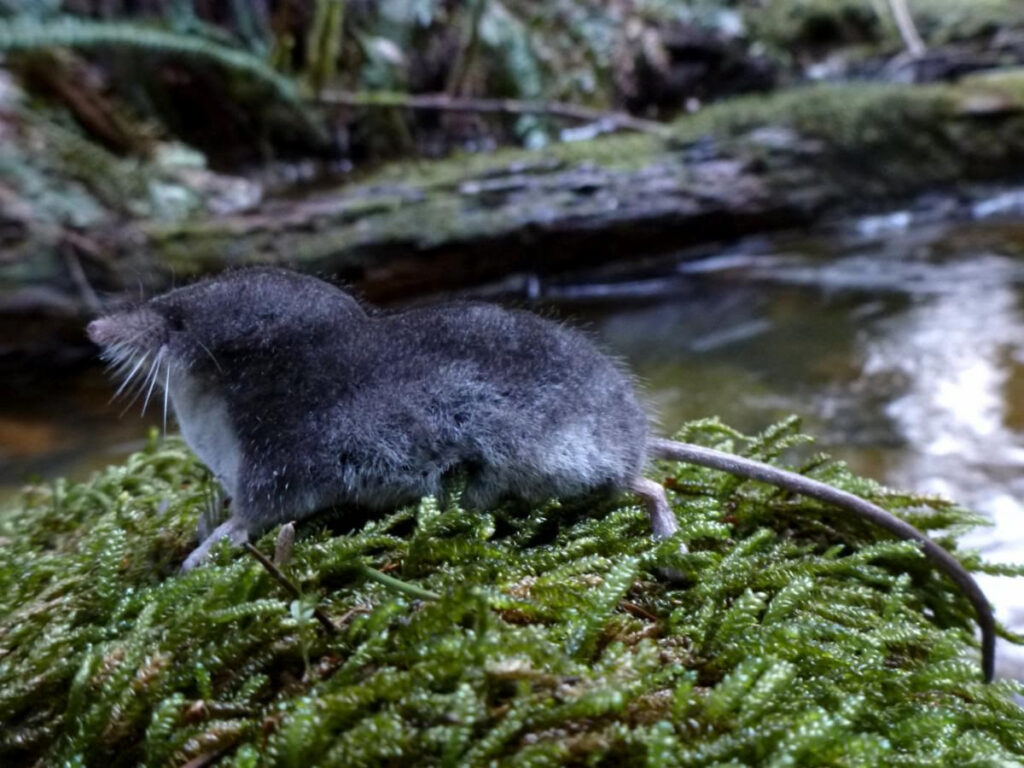
Despite living in a wide range of habitats, all shrews have one thing in common: an incredibly fast metabolism. With heartbeats ranging from 800 to 1500 beats per minute, shrews need to eat their body weight in food daily. Because of this, shrews are constantly consuming prey, including worms, insects, and even small mice and snakes. With poor eyesight, shrews rely on both touch and sound to navigate their environment. Using their sophisticated whiskers, called vibrissae, shrews are able to identify and quickly respond to potential prey. They also make small twittering noises that have been found to create echo scenes that help them assess their surroundings at close range (echolocation). Young shrews lack eyesight. When they are still reliant on their mom, they travel by holding onto each other’s tails and move in a large “conga” type line to keep hunting without losing anyone.
Due to their voracious appetite, shrews do not sleep or hibernate. Instead, they take short 2-3-minute naps throughout the day. When seasons change, and food becomes scarcer, they adapt by shrinking certain organs (including the brain, heart, and kidneys) to reduce their need for nutrients. Studies have found that their brains shrink by 20-30% and their skulls by up to 15% in winter. To ensure they do not perish from a lack of food, a significant number of shrew species are venomous. This venom is harmless to people (so harmless that it is being studied as a potential cancer treatment) but can paralyze prey so that it can be live cached until consumed (Hitchcock probably should have written ” The Shrews” instead of “The Birds”!).
Oregon is home to at least 10 unique shrew species with overlapping ranges, including 7 that call our service area home. Though we are relatively new to the shrew (compared to more familiar mammal friends like beavers) and haven’t yet identified the species found last week, what we have learned has us really excited to see these fascinating species exist and thrive in natural lands across our region.