

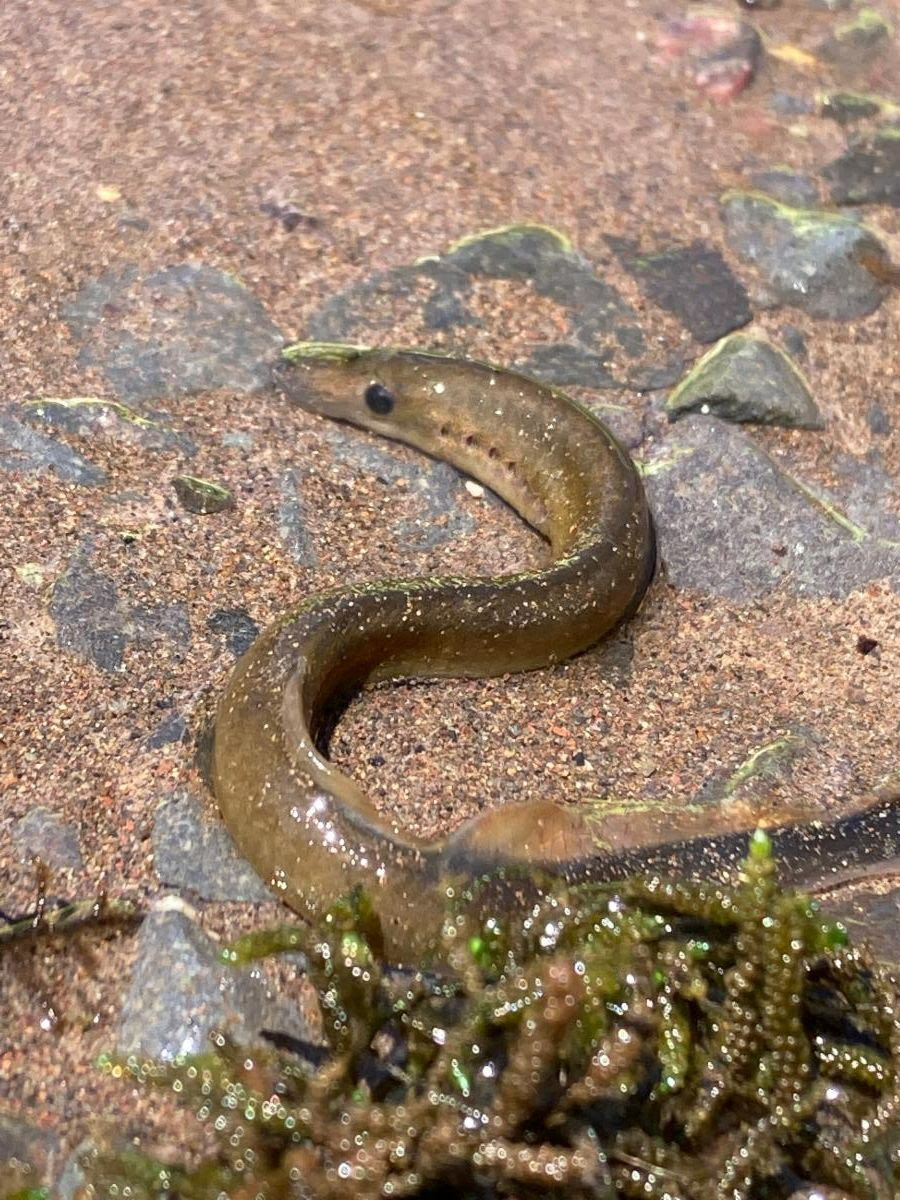
For the past 450 million years, lamprey have been navigating between mountainous streams and oceans across the Pacific Northwest. An ancient, jawless fish, lamprey are different from modern fish in their design. Their skeletons are made of cartilage, and they have no bones, scales, paired fins, or swim bladder. Instead, this eel-like swimmer has two dorsal fins on its back and a tail fin and breathes through gill pores on the sides of its body.
Lamprey spend most of their lives as larvae in the silt and mud along the riverbank. Congregating in large groups made up of multiple ages, lamprey will spend 3-7 years in this larval stage. Much like the well-known salmon, Pacific Lamprey require slow velocity side channels where nutrient-rich sediment collects along the river’s edge, providing food in the form of micro-nutrients and algae for their young.
During the larval stage, lamprey act as a “clean-up crew,” removing debris from the mud and sand on the stream bottom. Once matured, they’ll travel downstream to the Pacific Ocean, where they spend 1-3 years scavenging, hunting, and stealing food. The ocean phase of their life cycle is the only time when lamprey parasitize other fish for nutrients, using their specialized disc-shaped mouthparts and teeth.
Like salmon, adult lamprey return from the ocean to spawn in freshwater streams and rivers. Once they return to freshwater, they stop feeding as they swim upstream, heading for quiet side channels and pools, where they will lay up to 100,000 eggs in pebble nests called redds. Fertilized eggs hatch within 2-3 weeks, and the lamprey life cycle begins again, carrying on an ancient legacy between land and sea.
Protecting and restoring off-channel habitats is one way McKenzie River Trust members help ensure a future for lamprey and other threatened and endangered species in the Pacific Northwest. With your support, we can safeguard this ancient fish and the connections it continues to weave between land and sea.