
With the return of fall rains, western Oregon enters a season of transition. Rivers swell with new current, salmon surge upstream, mosses green across the forest floor, and wetlands brim with fresh water. These changes ripple outward, touching not only the rivers and trees but also the quiet lives of amphibians waiting for their moment to move.

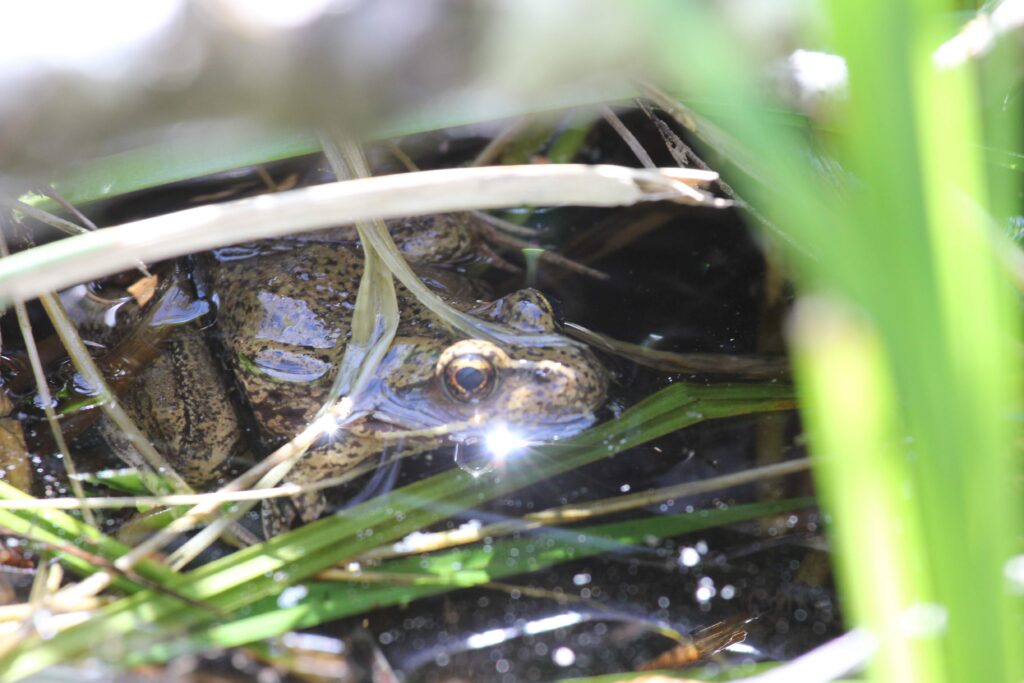
Among the first to answer is Oregon’s largest native frog, the northern red-legged frog (Rana aurora). Gold and orange legs flash briefly as they slip between forest and wetland, following a rhythm as old as rain itself. Their migrations are modest in distance—sometimes just a mile or two—but the complexity of their journey is immense. To breed, they need still-water ponds that last long enough for their tadpoles to grow. To feed, they rely on riparian edges and shaded forest. To survive, they must cross roads, ditches, and fields, connecting one habitat to another. Each piece is linked, and each link matters.

Why Habitat Connectivity Matters for Oregon’s Amphibians

In this way, the frogs reveal a truth often hidden in plain sight: strength lies not in any single place, but in the connections between them. Wetlands, forests, and uplands form a living network. When one thread frays, through drained marshes, fragmented migration routes, or the arrival of invasive bullfrogs, the rest of the web is pulled tight. Yet where connections remain, frogs endure.

This pattern is not theirs alone. Like salmon weaving together ocean and river, or migratory birds stitching continents through flight, red-legged frogs remind us of the intricate fabric of western Oregon. Just as their lives weave together forests, streams, and wetlands, our conservation efforts must knit together the landscapes we care for. A single pond is not enough; only a living network of healthy places will sustain these species in the future.

From the Cascades to the Coast: A Living Network of Care

This lesson also extends to us. Strong communities, like strong ecosystems, depend on diversity and connection. What began as protecting a single stretch of land on the McKenzie River has evolved into a shared effort spanning the coastline, valleys, and uplands of western Oregon, as neighbors, partners, and generations work together across place and time.

Not long ago, one of our land stewards spotted a red-legged frog on protected ground. On its own, the sighting was unremarkable: a small amphibian pausing in damp leaf litter. Yet within it lay a larger story, one that stretches back decades through community care and the steady work of keeping landscapes whole.

As the rains return and frogs set out on their seasonal journeys, they remind us of the quiet strength found in connection. Threading their lives across wetlands and forests, they show how complexity itself creates resilience, with each place supporting the next. In much the same way, our communities thrive when they are linked and diverse. What began along a single river has grown into something larger, an expanding network of care that weaves together communities across western Oregon, nourishing land, water, and people for generations to come.

Field Notes

Oak Trees: where worlds take root

With a history spanning millions of years, oak trees support thousands of species and anchor entire habitats within their spreading branches. Explore the remarkable history of oaks, the plants and animals that depend on Oregon’s oak woodlands and prairies, and why protecting these disappearing habitats matters for generations to come.
Read More »
Field Notes

Spring Chinook Salmon: the fish who feed our forests

Each fall, spring Chinook salmon return to the McKenzie River carrying nutrients gathered during years at sea. Follow their remarkable journey between river, ocean, and forest, and discover why giving rivers room to roam is critical to the next generation of salmon.

Read More »
Field Notes

Shaped by Water: Freshwater Sponges found at Green Island 

Beneath the surface of Green Island’s side channels, an unexpected animal is thriving. Freshwater sponges that build delicate skeletons of microscopic glass around the rivers’ flow. These fascinating animals filter the river through their bodies and can glow electric green with the help of algae. Their discovery has opened a window into a strange and largely unseen freshwater world where an animal completely different than ourselves is making its home among the current.

Read More »

Lasting conservation happens together.

Double your impact for land and water. $50,000 in donations will be matched dollar-for-dollar today!